Delphi Install Dpk Package

Install Error Messages
On this page, we have bundled the most frequently encountered issues with installing 3rd party components in general in Delphi or C++Builder. This applies to TMS components as well as to any 3rd party VCL component. The issues typically originate from an incorrect IDE setup. We hope this will be valuable information to quickly trace & solve the most common issues & mistakes with installing components.
General error messages
1. Error: Class..not found (when opening a project)
Please make sure ALL packages that are used for the component for which the error appears are installed & active. See menu Component, Install Packages in the IDE.2. Error: File not found xxxx.dcu
Please make sure to set your Delphi library path correct that it includes the folderwhere these DCU files are located. The library path can be configured under menu Tools, Options, Library - Win323. Error: Property .. does not exist
Before installing component updates, make sure that ALL old version files (DCU, BPL, BPI, LIB, DCP, HPP, OBJ . files) are removed from your Delphi or C++Builder library path. After installing new component versions and compiling applications that have been build with previous component versions, property errors can be raised upon running the applications. This is a common Delphi or C++Builder phenomenon. Solve this by first opening ALL forms in the application that use the updated component, ignore ALL property errors upon opening the forms, save the form files and after this, rebuild the application. The problem will be solved.4. Error: Could not compile used unit 'xxxx.pas'
Before installing component updates, make sure that ALL old version files (DCU, BPL, BPI, LIB, DCP, HPP, OBJ . files) are removed from your Delphi or C++Builder library path.5. Error: Can't load package .. .bpl
Add the folder where the package .BPL files are located to your system path.See Control Panel, System, Advanced Settings, Environment for editing the system path.6. Error: Cannot load package 'x'. It contains unit 'y', which is also contained in package 'z'.
In Delphi & C++Builder, a unit can be used in one package only. This error happens when you try to install two or more packages that use the same unit.To solve this, remove the unit(s) that is/are used in multiple packages from the package files (choose Remove from Project Manager). Then, from the IDE create a new package and add the unit(s) to this new package and compile this package. Then, in the packages where the unit was used, add a reference in the Requires list of the package to this new compiled package (.DCP file in Delphi / .BPI file in C++Builder) that contains the unit(s).More information about installing TMS Components with shared units can also be found here: https://www.tmssoftware.com/site/instcommon.asp
7. Error: procedure entry point could not be found
When errors are raised upon running the applications such as 'procedure @.. or the procedure entry point @.. could not be located', make sure to scan your hard disk for ALL old versions of package .BPL, package .DCP (package .LIB in C++Builder) files and delete ALL old versions. This error can appear when a project is built with a different version .DCP or .LIB file than the version that is loaded at runtime.8. Error: Ambiguity between 'xxxx' and 'unit::xxxx
In Delphi or C++Builder, constants with the same name but declared in different units can be used simultaneously. For example, the constant psOffice2003Blue is declared in both AdvPanel.pas & AdvOfficePagerStylers.pas. To use these constants in an application that uses both units, prefix the constant with its namespace, ie:For a TAdvPanel style, use AdvPanel.psOffice2003Blue and for a TAdvOfficePager style use AdvOfficePagerStylers.psOffice2003Blue
9. Error: Activation file has been created ..TMSPCKLIC.act. Please exit setup and activate your software
When errors are raised upon entering your registration email and code in the setup.exe such as 'Activation file has been created ..TMSPCKLIC.act Please exit setup and activate your software', make sure that an internet connection is available on your machine and that no firewall or antivirus software is blocking internet access for SETUP.EXE.When this issue ensured, delete the .ACT file and restart the SETUP.10. Error: [DCC Fatal Error] advgrid.pas(488): F1026 File not found: 'Windows.dcu'
When errors are raised upon installing the package tmsDXE2.bpl such as: [DCC Fatal Error] advgrid.pas(488): F1026 File not found: 'Windows.dcu', make sure that your unit scope names are setup correct in your IDE, project & packages. See: http://docwiki.embarcadero.com/RADStudio/en/Unit_Scope_NamesFor VCL UI Pack, unit scope names should be:
Data.Win;Datasnap.Win;Web.Win;Soap.Win;Xml.Win;Bde;Vcl;Vcl.Imaging;Vcl.Touch;Vcl.Samples;Vcl.Shell;System;Xml;Data;Datasnap;Web;Soap;Winapi;System.Win
11. Error: Unknown Parent namespace:embarcadero.rs_XXXX Insufficient permissions to complete action
When installing TMS help files and following error appears: 'Unknown Parent namespace:embarcadero.rs_XXXX Insufficient permissions to complete action' or'Unknown Parent namespace:embarcadero.rs_XXXX Parent NameSpace: embarcadero.rs_XXXX not registered'This indicates that the default help system in RAD Studio can't be found.
Can you make sure that:
1) The default help system in your IDE is installed & working
2) You execute the command RegHelp2.exe with the same user account as the user account with whichyou installed Delphi or execute it with admin privileges.
12. Error: function HTMLDrawEx(Canvas:TCanvas; s:string; fr:TRect; FImages: TCustomImageList;
[Error] HTMLENGO.PAS(406): Undeclared identifier: 'TCustomImageList'
If you use our HTML engine outside our components, you should add the unit ImgList to the uses list where this was used. Error messages in C++Builder
1. Error: [BCC32 Error] Uxtheme.hpp(37) E2257, expected
When errors are raised upon installing the package tmsc2010.bpl such as '[BCC32 Error] Uxtheme.hpp(37): E2257, expected', make sure to delete the uxtheme.h file in the TMS VCL UI Pack source folder and recompile. This file is required for older C++Builder versions but not anymore in C++Builder 2010. The same goes for dwmapi.hpp.2. Error: [Linker fatal error] Unable to open file 'xxxx.LIB'
When errors are raised upon compiling such as 'Error: [Linker fatal error] Unable to open file 'xxxx.LIB', make sure that xxxx.LIB is linked, you can force this with adding in the project source:#pragma link 'xxxx.lib'
Errors during installation with the automatic installer
If there is an issue on your machine during installation with the automatic installer, set Logging = true and send the install.log file that should have been generated under 'My documents' for investigation.1. Error: tmsdXXXX.dpk(165) Fatal: E2202 Required package 'vcl' not found OR tmsdXXXX.dpk(165) Fatal: E2202 Required package 'rtl' not found
This means that your Delphi library path is not properly setup.Please make sure that the folder is included in your library path where vcl.dcpis located, this normally is $(BDS)libFor multi-platform supported Delphi versions, please have a look at http://codeverge.com/embarcadero.delphi.ide/delphi-xe4-library-path-delete-invalid/1062669
2. Error: E2038 Illegal character in input file:
asgreg.pas(2) Error: E2038 Illegal character in input file: '`' (#$60)
asgreg.pas(2) Error: E2038 Illegal character in input file: ' (#$5C)
This means that there was an issue with the activation of the software.Please make sure that when you run the installer, that there is no software such as firewall / antivirus / proxy interfering with the internet connection via HTTP port 80 to http://www.tmssoftware.biz/ that the installer needs.Please turn-off any such software and retry the install.3. Error: C:Program FilesEmbarcaderoRAD Studio8.0bindcc32.exe cannot be found.
Normally, for a properly installed & non trial version of RAD Studio XE, the command line compiler DCC32.EXE should be available.If you have a trial version of RAD Studio XE, it is a known limitation of RAD Studio XE trial itself that the automatic installer will not work. To install for the RAD Studio XE trial , please do this manually from the IDE following the steps in INSTALL.TXT.4. Error: xlsadaptertmsXlsMessages.pas(8) Fatal: Could not compile used unit 'xlsadaptertmsUFlxMessages.pas'.
This means that you have not installed all Delphi 6 update packs, including the last RTL update.Please make sure to first install all Delphi 6 update packs and then install TMS VCL UI Pack.5. When installing the package TMS Scripter and following error appears: ascriptproXXXX.dpk(32) Fatal: E2202 Required package 'tmsdXXXX' not found.
This means that TMS VCL UI Pack is not properly installed in your Delphi. The TMS Scripter Installer has detected the package registered in your Delphi, but could not find 'tmsdXXXX' package file, required to compile Scripter Studio.6. Error: tmsdXXXX.dpk(607) Fatal: F2039 Could not create output file 'tmsdXXXX.drf'
This means that the user account executing the installer has no write permissions for the folder where the components are installed. Please verify this and choose a folder with no write limitations.7. Error: This version of the product does not support command line compiling
This means you're using a trial version of Delphi and it is a limitation of the Delphi trial version that it doesn't support command line compiling.Please install this on the full version of Delphi or do a manual install following the instructions in INSTALL.TXT8. Error: E2161 Error: RLINK32: Unsupported 16bit resource in file '..tmssoftwareTMS VCL UI Packxxxx.res'
This would hint at a failed activation of the software.Please retry to install, make sure there is no antivirus, firewall, other security tools that interfere with the internet connection our installer needs to activate the software.9. C:Windows>CALL MSBuild /target:Build /p:config=Debug /p:platform=Win32 /p:DCC_DcuOutput='MacHomeDocumentstmssoftware..MSBUILD : error MSB1009: Project file does not exist.
Installing from a network folder isn't supported. This is a shortcoming in MSBUILD. Please run the installer at least from a network drive.In this tip I draw together in one place information on how to install components into the Delphi IDE for various Win32 versions of Delphi. The notes also cover how to install IDE extensions or make simple units available in design time packages. The tip assumes you are installing source code, not pre-compiled units or packages.
Before you start copy all the files needed to install the component, IDE extension or unit into some suitable location on your hard disk. Files should include .pas files and any associated .dfm, .res, .dfm and, for components, .dcr files. Pirivom santhipom serial episode 171 online.
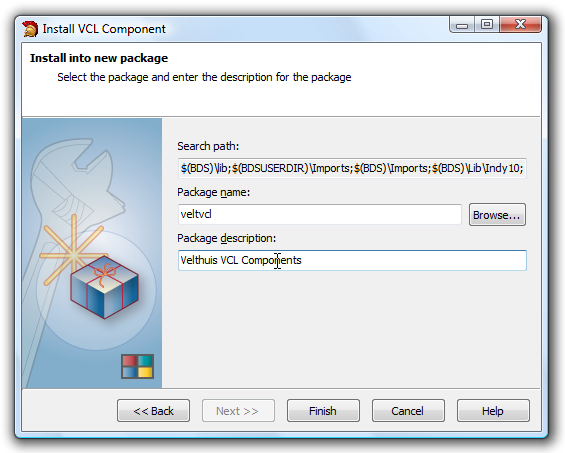
You then proceed differently for different versions of Delphi:
Installation with Delphi 2005 and later
For Delphi XE and CBuilder XE: sourceincludejcld15.inc; For FreePascal: sourceincludejclfpc.inc; In the IDE, open and compile package Jcl.dpk (or Jcl.bpk for CBuilder) located in a subdirectory of the 'packages' directory matching your version of the IDE. This package doesn't have to be installed since it doesn't provide any components. A package source file should be saved with the.dpk (Delphi package) extension to avoid confusion with other files containing Del source code. To open a package source file in the Code editor, 1 Open the package in the Package editor.
To add a component or IDE extension to the IDE it must be included in a design package. You can either create a new design package or add the component to an existing one. These instructions assume you will be installing into an existing package. See the Delphi help for information on how to create a new package. If your component came with its own package, use that.
- Open the required package. Select File Open menu and choose a suitable package source file (
.dpkextension. You may decide to install into the 'user' package that is often supplied with Delphi. - The selected package (with
.bplextension) will now be displayed in the Project Manager. If the package has not been installed yet right click the.bplentry in the Project Manager and select Install. Dismiss any resulting message dialogue. Now right click the
.bplentry again and select Add. What happens next depends on the version of Delphi.But in this Pokemon Liquid Crystal download, the day and night are now available and made more fun. Pokemon liquid crystal.
- For Delphi 2009 and earlier the 'Add' dialogue box will be displayed. Click the dialogue's Browse button then select the
.pasfile(s) to be installed from the resulting file open dialogue. The full path to the file(s) should now be displayed in the 'Add' dialogue's Unit file name edit box. Click OK to add the file(s) to the package. - For Delphi 2010 and later a simple file dialogue box will open from where you can choose the required
.pasfile(s). Just press OK to add the file(s) to the package.
- For Delphi 2009 and earlier the 'Add' dialogue box will be displayed. Click the dialogue's Browse button then select the
- Back in the Project Manager, check that the
.pasfile(s) you added appear under the package's 'Contains' node. Also check that any associated.dcrfiles also appear. If any.dcrfile does not appear you need to display the package's source file and add the line {$R FileName.dcr} to the code between the package name and the requires section. To display the source right click the package name in the project manager and select View Source. - If you are installing an IDE enhancement, like a property editor, make sure the
designidepackage is included in the package's requires section. - Now right click the
.bplentry again and select Compile. If no errors are displayed the package has been recompiled correctly. When adding components the package may need to be (re)installed. Right click the
.bplentry again and select Install. If all goes well a message should be displayed indicating that the component has been registered and it will appear in the appropriate tab of the Tool Palette (which will be named 'DelphiDabbler' when installing one of the components from the DelphiDabbler Code Library).Should a message appear saying that the installation has failed you will need to un-install the package and try again. How this is done depends on the version of Delphi.
- In Delphi 2009 and earlier select the Components Install Packages menu option then select the required package in the resulting dialogue box. Press the Remove button followed by OK. The package will now be uninstalled.
- In Delphi 2010 and later the
.bplentry's context menu has an Uninstall option. Simply click that option to uninstall the package.
- Close the package project using the File Close menu item. Accept any prompts to save the package project.
- If you wish you can now delete the
.pasfile. Other files must be left in place.
Building for 64 bit Windows (Delphi XE2 and later)
If the components etc. are compatible with 64 bit Windows add to a package as described above. Now add a Windows 64 bit target to the package project and rebuild.
Installation with Delphi 3 to 7
To add a component or IDE extenstion to the IDE it must be included in a design package. You can either create a new design package or add the component to an existing one. These instructions assume you will be installing into an existing package. See the Delphi help for information on how to create a new package. If your component came with its own package, use that.
- Open the required package. Select File Open menu, make sure that files with the
*.dpkextenstion are being displayed, and choose a suitable package source file. You may decide to install into the 'user' package. This is found in theLibsub-directory of your Delphi installation and is nameddclusr.dpkordclusrXX.dpkwhereXXis a version number. - The package editor will now be displayed. If its Install button is not disabled then click it to ensure the package is installed into Delphi. Dismiss any resulting message dialogue.
- Now click the package editor's Add button. The 'Add' dialogue box will be displayed. Click the dialogue's Browse button then select the required
.pasfile(s) from the resulting file open dialogue. The full path to the file should now be displayed in the 'Add' dialogue's Unit file name edit box. Click OK to add the file(s) to the package. - Click the package editor's Compile button. The package will now be recompiled and, if no errors are displayed, the package has been recompiled correctly. When adding components a message may be displayed at this stage indicating that the component has been registered. In some cases it is necessary to click the Install button after compiling before the component will be registered and the message displayed. Any components will now appear appropriate tab of the Tool Palette (which will be named 'DelphiDabbler' when installing one of the components from the DelphiDabbler Code Library).
- Now close the package editor window. You will probably be prompted to save the package. Agree to this and the package source file will be updated with information about the new component.
- If you wish you can now delete the
.pasfile. Other files must be left in place.
Installation with Delphi 2
- Select the Component Install menu option to display the 'Install Components' dialogue box.
- Click the Add button to display the 'Add Module' dialogue box.
- Click the Browse button and choose the required
.pasfile from the resulting standard file open dialogue box and click Open. - This returns you to the 'Install Components' dialogue box. Click OK here to rebuild the component library. If you were installing component it should now appear on the component palette (which will be named 'DelphiDabbler' when installing one of the components from the DelphiDabbler Code Library).
- If you wish you can now delete the
.pasfile. Other files must be left in place.
| Author: | Peter Johnson |
|---|---|
| Added: | 2009-10-06 |
| Last updated: | 2010-02-22 |
- ..
- 106
- ..
« Return to contents »