Bendix Scintilla Magneto Timing Manual
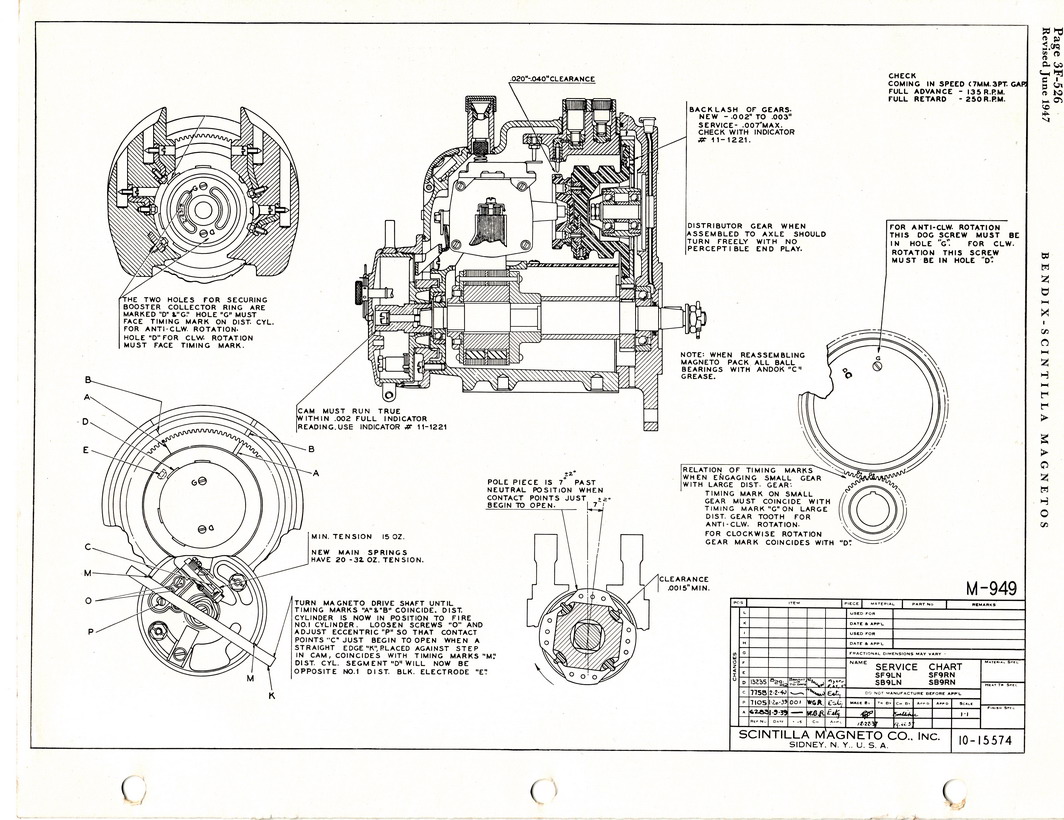
The left magneto retates, counter-clockwise, while the right one rotates clockwise as viewed the. Be just starting to open when this marks line up. Bendix timing light, No.11-851 or equivalent, should be use to determine when the breaker opens. Magnetos, Scintilla S 6 RI-51 and S 6 IN-64, which can be provided as.
Bendix Magneto
A magneto is an electrical generator that uses a permanent magnet to produce a current to start an aircraft's engine.
Magneto is not starting
When the impulse coupling fails, pieces will fall into the gears. When parts fall, the pieces jam the gear train. The crankshaft will then break off. This will cause the magneto to fail and so the engine will not start. If the impulse coupling is the problem, replace the impulse coupling.
Can't rotate the magneto to get timing
If the magneto is not timed correctly with the engine it will run rough or will not start.
Remove the retaining nut from the end of the magneto and remove the gear. Next, turn the gear 180 degrees. You then want to replace the gear, nut, and cotter key. Note: if the gear has an odd number of teeth, the timing will change by 1/2 a tooth.
Check the key on the magneto. A worn out key on the drive shaft will cause the drive to rotate without the magneto moving.
Check to make sure the magneto drive shaft is not broken. You can tell if the drive shaft is broken if there is scratched paint under the hold down clamp. The only way to tell if this is a problem is by the scratched paint or big timing change. Note: the shaft can have problems due to misalignment or mis-engangment which will put a side load on the shaft.

Broken distributor gear teeth on magneto
The aircraft will not start or will not run correctly.
Make sure the magneto was not turned while the timing lock was engaged in the distributor gear.
Check the excessive clearance between distributor block bushing and distributor gear shaft. This can cause a gear shimmy.
Make sure the temperature of the magneto is not too high. This can cause broken gear teeth.
Check the engine counterweights to make sure they are working properly.
Rough Engine
This problem will be noticed if the engine runs poorly and the aircraft shakes.
Check the rough coil in the magneto. Rough coils usually break when they get too hot. Delphi install dpk package. If your aircraft switches from running smooth to running rough, a broken rough coil can cause this. Once the coil is removed perform a heating test by heating it to 140 degrees F for an hour then run the magneto again. If the engine runs poorly replace the rough coil.
Excessive RPM drop on left/right aircraft magneto
This problem will be noticed if the RPM instrument drops excessively.
Check for a shorted shower of sparks vibrator. This will cause it to stay in a retorted position on the left magneto. If this is the problem, replace the sparks vibrator.
Be sure you are using the correct fuel
Check for an induction leak. A leak can cause a mixture that can ignite when both spark plugs fire.
Check for a failed magneto capacitor. If this is the problem, replace the capacitor.
Illustrated parts list of Bendix magneto
This article focuses on one specific item of maintenance performed during an effective 100 hr. inspection on R985 and R1340 engines: Ignition timing check.
- Oil Change with filter/screen & sump checks.
- Valve adjustment – Positive or compression.
- Ignition timing check – Spark plug servicing.
- Compression check – differential.
- Air filter and carb – heat system check.
- Fuel System Screens.
- Cylinder Head Checks.
Ignition timing check: The only “external” timing position indicator the engine has is on the steel thrust-bearing-liner flange underneath the thrust bearing cover! You have to establish timing position with some type of mechanical indicator like a Time-Rite piston position indicator or some other type of mechanical indicator that attaches to the propeller. On the geared engines you will need a probe such as a fiberglass or plastic rod to insert in the front sparkplug hole to feel for the #1 piston travel. And of course, a timing-light or buzz-box with leads capable of reaching the magneto points or P-leads will be necessary.
The magnetos time to 25 deg. BTC #1 cylinder, compression stroke. If your timing is off more than 1-1/2 deg., the timing should be adjusted. It is important to determine why the timing is off before removing a magneto to reset timing. Bosch magneto points are set with a 0.008 inch to 0.010 inch point-gap at overhaul or bench check. Magneto timing to the engine will become retarded if the cam follower on the magneto wears. This wear can result in point gap that is too close for the magneto to function properly if the magneto is removed and timing adjusted by rotating the drive grommet. If the cam follower wears to the extent that the points can no longer open, then the magneto will no longer work.
Check the Distributor Rotor and Cam attach nut/timing collar for rotational slack prior to adjusting timing. Normal rotational slack in this rotor shaft should be 0.002 to 0.010 inch. More rotational slack than prescribed can indicate worn distributor rotor gearing or a loose gear ring on the distributor rotor.
Point follower wear is much more of a problem on the Bosch magneto than it is on the Bendix magnetos. Point gap is also less on the Bosch (.008: to .010″ at overhaul). A physical point gap check should be made on the Bosch magnetos every time magneto timing is checked. It is recommended to put a few drops (2-3) of 60 wt. on the felt lubricator around the cam of the Bosch magneto. One “small” drop should be placed on the lubricator portion of the point spring-half on the Bendix SB9RN and SB9RN-4 magnetos.
Bosch magneto point sets have two platinum plated contacts, one on a leaf spring and the other on an “L” shaped point base. If Bosch magneto ignition point closure below 0.008 inch is found, point gap can be readjusted as follows: Set the engine to #1 cylinder, 25 degrees before top dead center, compression stroke and slightly loosen the magneto point base retainer screw. Place the timing light on that magneto’s P-lead or spring half attach screw being careful to avoid grounding of the lead and turn the timing light on (magneto switch must also be switched on). Turn the eccentic adjusting screw in the point base until the timing light indicates points open. Re-tighten the point base attach screw. Re-check magneto timing by rotating the prop.
If timing is off more than three degrees the magneto should be removed and bench checked for bearing wear, point follower wear, gear wear, etc., and reinstalled.
The overhaul manual calls for 0.020 inch to 0.030 inch slack or clearance are maintained on the rubber magneto drive grommets at installation. This is very critical on the Bendix SB9RN magnetos to prevent preloading the rear rotor shaft bearing thus causing distress.
Removing the magneto and resetting timing: Mark the grommet and its gears with a visible marker, remove the magneto-attach screws (bolts) and lift the magneto up and back. It is best to keep the drive grommet against the magneto gear while preventing the magneto gear from turning. With the magneto held in one hand rotate the rubber drive-grommet right or clockwise to retard, left to advance. One (1) tooth equals .7 degrees. It works to consider each tooth as 1 degree timing change unless more than 5 degrees is required. Place the magneto back on the mount pad, install and tighten one bolt then verify the timing. Install the remaining bolts and torque to 200- 270 in. lbs. and safety.
It is important to verify that you are installing the magneto with it in the #1 cylinder firing order! The markings for #1 firing position differ on all three types of magnetos used on these engines!
TIP: A #2 Phillips screwdriver bent to approximately 35 degrees- 1 ½ inches down from the tip makes a good installation tool. You’ll need something to overcome compression of the rubber drive grommet during installation!
Let me say a word or two on spark plugs. Massive electrode spark plugs should be serviced every hundred hours or so, cleaned, gapped .016″ to .019” and fresh anti-seize applied.
Caution: Nothing kills a spark plug quicker than excessive or sloppily applied anti-seize. 3 1/2 threads up from the gasket are sufficient. If you can’t screw a sparkplug in all the way by hand, the sparkplug bushing threads should be cleaned with a thread-chase tap. A thread tap will lock up in a heli-coiled hole so avoid using them in anything other than original brass sparkplug bushings. Remember to apply air pressure to the other plug hole to blow chips out of the cylinder during chasing/tapping. If air isn’t available, use a coating of grease on the chase-tap.
Ya’ll Fly Safe!